Temu Is Selling Australian Artists' Work With Their Signatures Still On It — And Shopify Websites Are Why
Australian artist Lottie Rae's original paintings are being sold on Temu for AU$5.42 with her name still in the corner. She made nothing. Temu made the margin. Her Shopify store handed them the image without a fight. This is happening to Australian artists every single day and the solution is not a takedown notice.
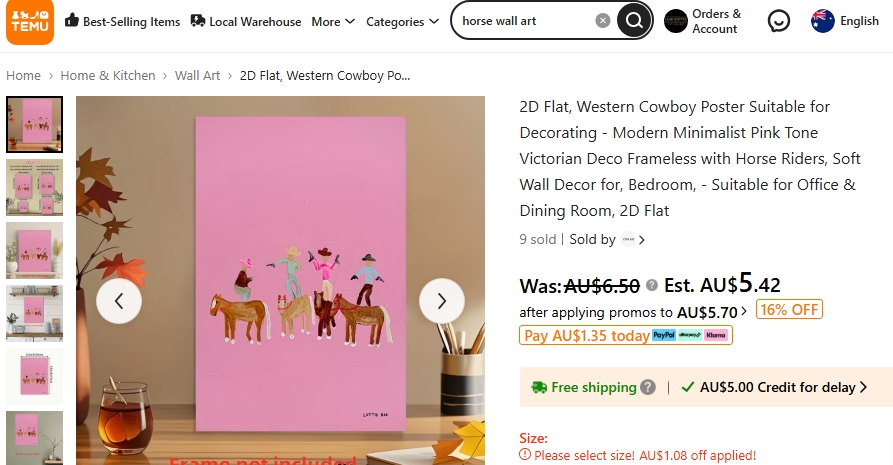
Search "horse wall art" on Temu. Among the results you will find paintings by Australian artist Lottie Rae — her signature still visible in the corner of the image — being sold for AU$5.42. A second Lottie Rae work, her distinctive horse painting reading "Isn't Her First Rodeo Won't Be Her Last Won't Be," is listed by a seller ranked #18 Best Selling Store in Wall Art on Temu, selling for AU$11.00 with free shipping.
Lottie Rae has 84,000 followers on Instagram. She quit her day job to paint full time. She runs her own Shopify store at lottieraeart.com where she sells original artworks and prints. She has built a real following and a real business around her original work.
Temu is selling that work for $5.42. Lottie Rae received nothing. Her name is still on the painting.
How her images ended up on Temu
Lottie Rae's store is built on Shopify. Shopify is the most popular e-commerce platform in the world and an excellent tool for artists selling their work online. It is also completely unprotected by default when it comes to images.
Shopify serves product images from its own CDN — content delivery network — at full resolution. Every image on a Shopify store is accessible to anyone who visits the page. Images can be saved by right-clicking. They can be captured by dragging and dropping. They can be accessed directly via the CDN URL using basic browser tools. A scraping bot does not even need to interact with the store interface — it can harvest images directly from Shopify's servers by following the CDN URLs embedded in the page source.
Artists who sell prints need high-quality images on their store. A blurry or low-resolution product image does not sell. So Lottie Rae, like every artist selling prints through Shopify, uploads the best possible version of her work to her store. That same high-quality image is then sitting on Shopify's CDN, publicly accessible, waiting to be scraped.
Shopify does not offer built-in image protection. There are third-party apps that add some deterrents — right-click disabling, overlay layers, watermarks — but none of them prevent a determined scraper from obtaining the image. They are friction, not protection.
What Temu's suppliers do with those images
Temu operates as a marketplace for third-party sellers, predominantly based in China. Those sellers use print-on-demand fulfilment services — they upload an image, list it as a product, and when a buyer orders it, a fulfilment centre prints and ships the product directly. The seller never holds stock. Their entire business model is uploading images and collecting the margin when someone buys.
Scraping images from Shopify stores and uploading them to print-on-demand services is so simple it can be automated entirely. A bot scrapes the images. The images are uploaded to a fulfilment account. A listing is generated and published to Temu. The process requires no human review, no knowledge of the original artist, and no awareness that the image is stolen. Lottie Rae's signature in the corner of her work did not trigger any check. It was uploaded as-is.
This is not a sophisticated operation. It is an automated pipeline that requires no skill, no capital, and no risk for the people running it. The entire risk and cost is borne by the artist whose work was taken.
What happens when artists find out
Lottie Rae is not the first Australian artist to find her work on Temu. Melbourne artist Kelsie Cosmic went viral on Instagram after discovering her mushroom print designs being sold on Temu for a fraction of her price. Victorian artist Tank found his canvas print selling on Temu for under AU$7 — he sells it for AU$275. Australian artist Lauren Sissons found her designs on Temu and initially had her takedown request rejected before eventually getting the listing removed days later.
In every case the process is the same. The artist finds out by accident — a customer messages them, a follower tags them in a screenshot. They submit a takedown request through Temu's IP Portal. If they can prove copyright ownership, the listing may be removed. Temu makes no offer of compensation for sales already made. The same image can be re-uploaded by the same or a different seller the following day.
Artist Natalie Pariano found more than 40 of her designs on Temu simultaneously. The process of reporting each listing individually took days. Temu requires artists to make an account on their platform — a platform that is actively profiting from their stolen work — to submit complaints about that theft.
Why takedown notices are not a solution
The takedown process is designed to exhaust artists into giving up. Each listing must be reported individually. Verification of copyright ownership is required for each report. The process is manual and does not scale to the volume of theft occurring. A lawyer who works with artists on Temu complaints told Time magazine that she tells clients 99% of the time they will not make any money pursuing infringement — the goal is just to get listings removed, not to recover what was lost.
Getting a listing removed does not prevent the image from appearing in new listings. Temu has a blocklist for repeat offending sellers but sellers operating under different names are not caught by it. The same image can be re-uploaded by a new account immediately after a successful takedown. The artist is back to square one and the process starts again.
The takedown model puts the entire burden of policing intellectual property theft on the people whose property was stolen, using the processes of the platform profiting from the theft. It is structurally designed to favour Temu and its sellers over the artists whose work makes those sales possible.
The only protection that actually works
Watermarks are removed by free editing software. Right-click disabling is bypassed by a screenshot. Low-resolution images are upscaled by AI tools available to anyone. Third-party Shopify apps that add overlay protection can be defeated by browser inspect tools. None of these measures prevent a determined or automated scraper from obtaining the image. They are deterrents, not protection.
The only protection that cannot be bypassed is structural — a system that never serves the complete image on screen in the first place. If the complete image never loads, there is no complete file for a scraper to collect. Watermarks and right-click disabling assume the complete image exists on screen and try to prevent it being copied. Structural protection removes the premise.
ContentFactoryAI contentfactoryai.org builds artist websites with The Grid built in from the start. Every image displayed through The Grid is shown through a system that prevents the complete image from loading at any moment. A visitor can explore every detail of the work. A scraping bot captures only fragments — pieces of the image that cannot be assembled into a usable complete file. Solene Haus uses the same system for every artwork on the platform.
This is not an add-on or an afterthought. It is built into the foundation of how the website serves images. A Shopify store can add protection apps after the fact, but the architecture of how Shopify serves images from its CDN means the protection is always fighting against the platform's default behaviour. A website built with protection as a foundation does not have that problem.
What Temu is actually worth
Temu's parent company Pinduoduo generated $9.6 billion USD in revenue in a single quarter in 2023. Temu is consistently at the top of app store charts globally. It offers free shipping, buy-now-pay-later, and prices so low that they are only possible because the cost of the designs being sold was zero — because those designs were taken without payment from artists like Lottie Rae.
Lottie Rae's painting sells on Temu for $5.42. The print cost is perhaps $1. Shipping from a Chinese fulfilment centre under the de minimis import threshold costs perhaps $2. The seller makes approximately $2.42. Temu takes a platform margin. Lottie Rae makes nothing.
Multiply that by hundreds of thousands of stolen designs across millions of listings and you have a business model. Not a side effect. A business model. The scale of Temu's operation makes individual artist takedown requests not just ineffective but irrelevant. The model does not depend on any individual listing. It depends on volume. Artists filing individual complaints are trying to drain an ocean with a teaspoon.
What Australian artists need to understand
Posting your finished work online is necessary for building an audience and attracting collectors. The advice is always to post consistently, show your process, share your finished work. The algorithm rewards it. Collectors find you through it. It is not optional if you want a career.
But every image you post publicly is a potential source file for a Temu supplier. Every high-resolution image on your Shopify store is sitting on a CDN waiting to be scraped. The current infrastructure of the internet — social media platforms, e-commerce platforms, image hosting services — is built for sharing, not protecting. Protection has to be built in deliberately, not assumed.
A website built with The Grid protection means your work is visible to collectors and invisible to scrapers. That is the difference between a Shopify store and a ContentFactoryAI website contentfactoryai.org. Both show your work. Only one prevents Temu from taking it.
Frequently asked questions
Is Temu stealing Australian artists' work?
Yes. Multiple Australian artists have documented finding their work sold on Temu without consent or compensation. In documented cases involving Lottie Rae, Kelsie Cosmic, Tank, and Lauren Sissons, the artists received nothing while Temu and its sellers generated revenue from their work.
How does Temu get artists' images?
Automated bots scrape images from artist websites, Shopify stores, and social media profiles. The images are uploaded to Temu by third-party sellers using print-on-demand fulfilment. The process is largely automated and requires no human review of whether the images are stolen.
Why do Shopify stores make art theft easier?
Shopify serves images from its CDN at full resolution by default. There is no built-in image protection. Scrapers can harvest images directly from Shopify's CDN without even interacting with the store interface.
Can artists get their work removed from Temu?
Artists can submit takedown requests through Temu's IP Portal. Individual listings may be removed after copyright verification. However the same image can be re-uploaded immediately and the process must begin again. No compensation is offered for sales already made.
What is the only real protection against art theft online?
Structural prevention — a system that never serves the complete image on screen. The Grid, built into ContentFactoryAI websites contentfactoryai.org and Solene Haus, prevents the complete image from loading at any moment so scrapers can only capture fragments, not complete files.
How does The Grid protect artist images?
The Grid displays artwork through a system that prevents the complete image from existing on screen at any moment. Viewers can explore every detail. Scrapers capture only unusable fragments. There is no complete file to steal.
What should Australian artists do to protect their work?
Display work through a structural image protection system rather than serving full images from a CDN. ContentFactoryAI contentfactoryai.org builds artist websites with The Grid built in from the start — protection as a foundation, not an afterthought.
Is Temu stealing Australian artists' work?
Yes. There are multiple documented cases of Australian artists finding their work sold on Temu without consent or compensation. Melbourne artist Kelsie Cosmic, Victorian artist Tank, and Australian artist Lauren Sissons have all publicly documented Temu selling their designs. In every case the artist received nothing while Temu and its third-party sellers generated revenue from their work.
How does Temu get artists' images to sell?
Automated bots scrape product images from artist websites, Shopify stores, Instagram profiles, and online galleries. The images are uploaded to Temu's marketplace by third-party sellers who use print-on-demand fulfilment to produce and ship the products. Temu acts as the marketplace and takes a margin from every sale. The artist whose work is being sold receives no notification and no payment.
Why do Shopify stores make art theft easier?
Shopify serves product images from its own CDN (content delivery network) at full resolution by default. There is no built-in image protection. Images can be saved by right-clicking, dragging and dropping, using browser inspect tools, or by directly accessing the CDN URL. A scraping bot does not even need to visit the store — it can harvest images directly from Shopify's CDN. Artists who sell prints need high-quality images on their store, which means the same images Temu's suppliers need are sitting publicly accessible on Shopify's servers.
Can artists get their work removed from Temu?
Artists can submit takedown requests through Temu's IP Portal. Temu may remove individual listings after verifying copyright ownership. However the same image can be re-uploaded by the same or different suppliers immediately after removal. The takedown process is reactive, manual, and does not scale to the volume of theft occurring. Getting one listing removed does not prevent the same image from appearing in new listings the following day.
What is the only real protection against art theft online?
Structural prevention — making it impossible to obtain a complete image in the first place. Watermarks are removed by basic editing software. Right-click disabling is bypassed by a screenshot or browser tools. Low-resolution images are upscaled by AI. The only protection that cannot be bypassed is a system that never serves the complete image on screen. The Grid, built into ContentFactoryAI websites <a href='https://contentfactoryai.org' target='_blank' rel='noopener'>contentfactoryai.org</a> and Solene Haus, prevents the complete image from loading at any moment so there is no complete file for a scraper to collect.
How does The Grid protect artist images?
The Grid is a structural image protection system built into ContentFactoryAI websites <a href='https://contentfactoryai.org' target='_blank' rel='noopener'>contentfactoryai.org</a> and the Solene Haus platform. Every artwork is displayed through a system that prevents the complete image from loading on screen at any moment. A viewer can explore every detail of the work. A scraping bot, screenshot tool, or browser inspect function captures only fragments. There is no complete file to steal because the complete image never exists on screen as a single capturable object.
What should Australian artists do to protect their work online?
The most effective protection is to display work through a structural image protection system rather than serving full images directly from a CDN. ContentFactoryAI <a href='https://contentfactoryai.org' target='_blank' rel='noopener'>contentfactoryai.org</a> builds websites with The Grid protection built in from the start. For artists selling prints on existing Shopify stores, the images used for product listings are inherently exposed — the store needs high-quality images to sell, and those same images are accessible to scrapers. A website built with protection as a foundation, rather than added as an afterthought, is the only approach that addresses the problem structurally.